No product featured
Firing the Best Employee: A Workplace Paradox in Text
A walking selfie uses a static workplace story overlay to contrast an employee’s apparent disengagement with her indispensable contribution, creating curiosity about the firing.
- Views
- 11.1M
- Likes
- 45.4K
- Comments
- 2.3K
- Length
- 12s
Observed : 11,086,534 views, 45,436 likes, 2,310 comments. Published . An Instagram view is a play of a video (Reels); images and carousels have no views.
First 3 seconds
- Visual
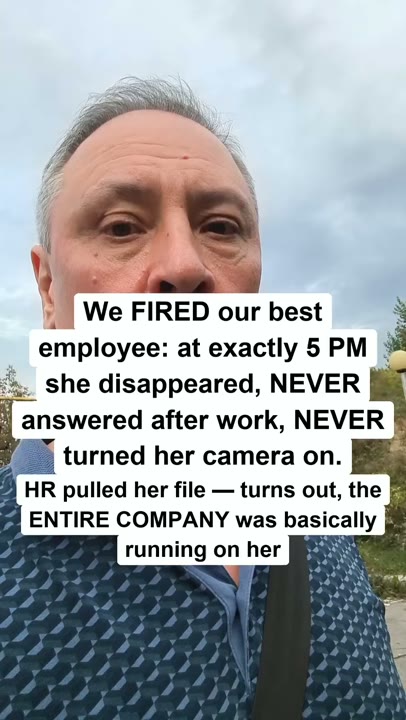
- The creator walks outdoors in a close handheld selfie, with cloudy sky and foliage behind them; large stacked text covers the central frame.
- On-screen text
- “We FIRED our best employee: at exactly 5 PM she disappeared, NEVER answered after work, NEVER turned her camera on. HR pulled her file — turns out, the ENTIRE COMPANY was basically running on her”
- Spoken line
- None: no speech in the opening
- Sound
- Instrumental synth-beat music with no spoken voice, according to the prior audio analysis.
Script beats
The full overlay immediately introduces firing the best employee, lists perceived disengagement, and states her hidden importance.
Stop the scroll with a contradiction and give viewers a dense story to read
The creator turns their head while continuing the outdoor walk; the overlay stays unchanged.
Maintain casual visual movement while viewers process the story
Trees and foliage shift behind the creator as the same text remains visible.
Provide reading time and reinforce the contrast between visible availability and actual contribution
The walking selfie continues through the final frame without a new overlay or visible resolution.
Leave the consequences of the firing unresolved, encouraging further interest in the caption
Why it works
- contradiction. “FIRED our best employee” pairs a punitive decision with exceptional performance, making viewers seek an explanation.
- self-recognition. Logging off at 5 PM, ignoring after-hours messages, and keeping a camera off are recognizable workplace behaviors.
- reversal. The HR discovery reframes apparent disengagement as indispensable work, challenging the judgment presented above it.
- reading time. The entire story appears immediately, but its length gives viewers a reason to linger while the simple background keeps moving.
How to adapt it
- The underestimated product. A kitchen tool dismissed as unnecessary, a plain moisturizer overlooked for its packaging, or a budgeting app nearly deleted.
- The mistaken judgment. “It only does one thing,” “it looks too basic,” or “I hardly ever open it”—followed by a truthful explanation of its value.
- The evidence that reverses the judgment. Show meal-prep time saved, a documented skincare routine result, or recurring charges identified by an app.
- The casual background. Film a phone selfie on a walk, in the kitchen, or beside a desk while keeping the overlay easy to read.
- Keep intact.
- Open with a clear contradiction between dismissal and value
- Use specific behaviors or objections before the reversal
- Make the reversal explain why the initial judgment was wrong
- Keep the text legible and visible long enough to read; this version shows everything from the start
Pattern template
I nearly [discarded/stopped using] [product] because [specific objection] — then [evidence] showed it was responsible for [valuable outcome].
Keywords and tags
- Audience
- Employees and managers interested in remote work, after-hours boundaries, and how performance is judged
- Angles
- Curiosity, Relatability, Surprise
- Sound
- Music only
Video and caption by @urman_geen; original post on Instagram. Breakdown by UGC Growth Engineer, added .