Wordleword puzzle gameUnbrandedbrain-training appUnbrandedonline challenge game platformSudoku.comsudoku game
Logic Games as an Alternative to Doom-Scrolling
A text-overlay Reel contrasts doom-scrolling with logic games, then reveals puzzle apps through screen overlays over casual indoor footage.
- Views
- 80.8K
- Likes
- 3
- Comments
- 368
- Length
- 10s
Observed : 80,830 views, 3 likes, 368 comments. Published . An Instagram view is a play of a video (Reels); images and carousels have no views.
First 3 seconds
- Visual
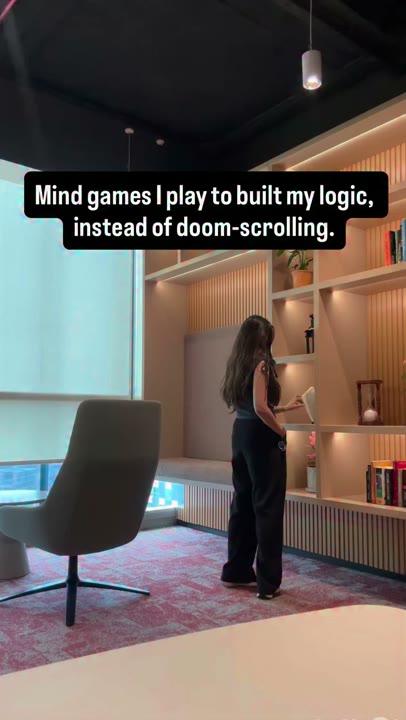
- A static wide shot shows the creator beside wooden shelves, looking down at an open book-like object and slowly stepping across the room.
- On-screen text
- “Mind games I play to built my logic, instead of doom-scrolling.”
- Spoken line
- None: no speech in the opening
- Sound
- Upbeat instrumental music with no voiceover, according to the prior audio analysis; the transcript detects no speech.
Script beats
The creator moves casually beside shelves beneath the promise of logic games instead of doom-scrolling.
Contrast a familiar unwanted habit with an appealing alternative and create curiosity about the recommendations
A Wordle puzzle screenshot appears over the continuing room footage.
Start answering the promised list with a recognizable game
A colorful brain-training interface shows sections including Brain Workout and All Games.
Expand the recommendations with a visibly varied game collection
A dark game dashboard displays daily challenges and duel modes.
Maintain momentum with another concrete option and a contrasting interface
A Sudoku.com grid appears over the room footage.
Provide another specific example of the proposed puzzle habit
The screen overlays clear; the final frame asks viewers to comment “logic” for links.
Convert interest in the recommendations into a keyword comment
Why it works
- habit contrast. The opening explicitly contrasts doom-scrolling with a more purposeful screen activity, giving viewers a clear reason to care.
- unresolved list. “Mind games I play” promises specific recommendations that are withheld until after the opening.
- concrete visual payoff. Game interfaces make the recommendations tangible without requiring narration.
- easy next step. The final keyword comment offers a simple way to request the links.
How to adapt it
- Habit and desired benefit. For a language app, contrast scrolling with vocabulary practice; for a meal-planning app, contrast browsing recipes with planning dinner.
- Product examples. Replace the puzzle screenshots with three app lessons, three meal-planning features, or three guided creative exercises.
- Background footage. Film a static phone shot of the creator reading at home, sitting at a desk, or walking beside a bookshelf.
- Closing keyword. Use “Comment ‘learn’ for the app links” or “Comment ‘meals’ for the planner,” when those resources are available.
- Keep intact.
- Make the unwanted habit and appealing alternative readable immediately
- Promise specific options, then show them shortly after the opening
- Use large, legible product screenshots over simple background footage
- Keep the closing keyword directly related to the promised recommendations
Pattern template
[Tools] I use to [desired benefit], instead of [unwanted habit] → [specific screen examples] → comment “[keyword]” for [resource].
Keywords and tags
- Audience
- People who want puzzle-game alternatives to doom-scrolling.
- Angles
- Relatability, Curiosity, Aspiration
- Call to action
- Comment “logic” for the links 🔗
- Sound
- Music only
Video and caption by @codecrookshanks; original post on Instagram. Breakdown by UGC Growth Engineer, added .