ClaudeAI assistant
Contrarian AI Job-Search Claim With a Numbered Result
A desk-work video uses text overlays to pair a contrarian claim about Claude with six interview calls in seven days, then promises the prompts behind the result.
- Views
- 694K
- Likes
- 2.7K
- Comments
- 902
- Length
- 9s
Observed : 693,726 views, 2,683 likes, 902 comments. Published . An Instagram view is a play of a video (Reels); images and carousels have no views.
First 3 seconds
- Visual
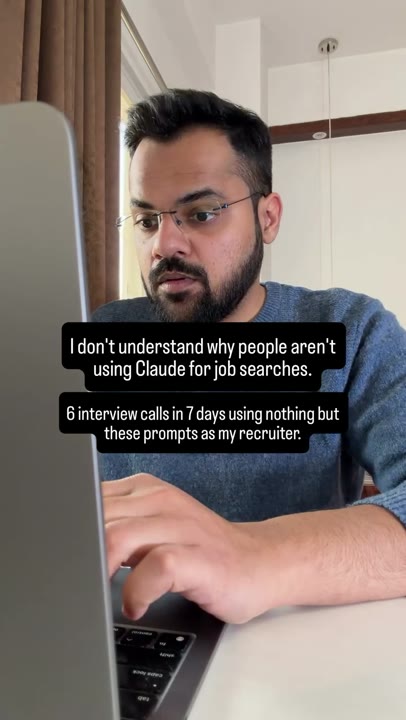
- The creator sits behind a laptop, typing with a focused expression in a static vertical shot.
- On-screen text
- “I don't understand why people aren't using Claude for job searches. / 6 interview calls in 7 days using nothing but these prompts as my recruiter.”
- Spoken line
- None: no speech in the opening
- Sound
- Soft background music without narration, according to the prior analysis; the transcript detects no speech.
Script beats
Desk typing footage carries a contrarian statement about Claude and a claim of six interview calls in seven days.
Stop job seekers with a desirable, specific outcome and suggest they are overlooking a useful tool
A third overlay appears by 3.64 seconds: 'Here are the 6 prompts that made it happen:'
Turn interest in the claimed result into curiosity about a finite, actionable resource
All three overlays remain over the same desk footage through the ending; the supplied caption begins listing prompts.
Give viewers time to read and direct attention toward the caption for the promised method
Why it works
- Contrarian framing. The opening implies that an overlooked tool could improve a familiar struggle, prompting viewers to reconsider their job-search approach.
- Specific outcome. Six interview calls in seven days makes the benefit concrete and easy to grasp, although the evidence does not verify that result.
- Unresolved method. The reference to 'these prompts' creates curiosity immediately, and the later numbered promise specifies what viewers can learn.
- Everyday context. Simple laptop footage connects the claim to a recognizable work routine and keeps attention on the readable overlays.
How to adapt it
- Product and task. Use a scheduling app for booking clients, a meal-planning app for organizing dinners, or a budgeting app for tracking spending.
- Measured result and timeframe. Substitute a documented result such as 'planned five dinners in 15 minutes' or 'booked three client calls this week.'
- Numbered resource. Promise three scheduling settings, five meal templates, or four budget categories, then provide them in the caption.
- Background activity. Film yourself checking a calendar, preparing ingredients, or reviewing expenses while the text carries the hook.
- Keep intact.
- Put the contrarian statement and concrete benefit on screen immediately
- Make the outcome specific and support any adapted result claim with real evidence
- Connect the result to a clear method viewers can access
- Keep the footage simple and the overlays readable long enough to absorb
Pattern template
I don't understand why people aren't using [product] for [task]. → [specific result] in [timeframe] using [method]. → Here are the [number] [steps/resources] that made it happen:
Keywords and tags
- Audience
- Job seekers who want more interview callbacks and help improving their application materials
- Angles
- Curiosity, Fomo, Aspiration
- Call to action
- Implicit invitation to read the caption's prompt list: 'Here are the 6 prompts that made it happen:'
- Sound
- Music only
Video and caption by @shubhamnalingupta; original post on Instagram. Breakdown by UGC Growth Engineer, added .