radcamphoto-editing app
- Bold claim
- Demo
- Apps and software
- Brand’s own account
A 30-Second Photo App Promise Followed by Visible Proof
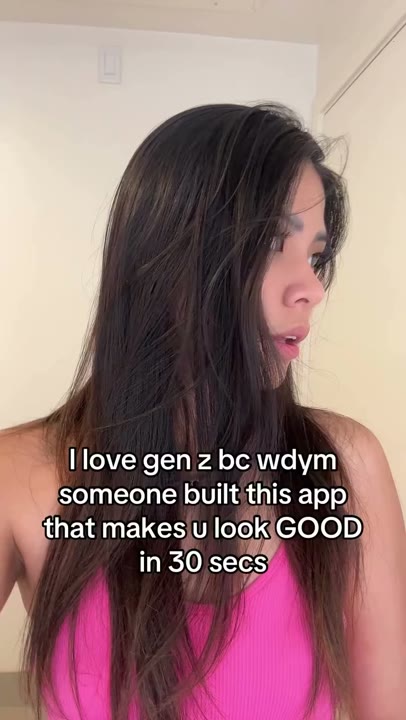
A selfie reaction pairs a 30-second photo-editing app promise with a screen recording that reveals a warmer, golden-hour result.
- Views
- 131K
- Likes
- 3.8K
- Comments
- 37
- Length
- 11s
Observed : 130,940 views, 3,842 likes, 37 comments. Published . An Instagram view is a play of a video (Reels); images and carousels have no views.
First 3 seconds
- Visual
- The creator turns from looking sideways to facing the selfie camera, widens their eyes, and covers their mouth by about three seconds.
- On-screen text
- “I love gen z bc wdym someone built this app that makes u look GOOD in 30 secs”
- Spoken line
- None: no speech in the opening
- Sound
- The prior analysis reports pop music with sung vocals and no creator voiceover; the transcript detects no speech.
Script beats
The creator turns toward the camera while the text promises an app that makes users look good in 30 seconds.
Combine a desirable, time-bound benefit with casual discovery language
The creator widens their eyes and raises a hand over their mouth.
Reinforce the promise with an expressive surprise reaction
A cut introduces an app screen recording with a portrait outside KALI and editing controls.
Move from the claim to a concrete product demonstration
The interface shows AI Flash options, a GOLDEN HOUR selection, and a generating state.
Show the feature and establish a brief wait for the result
The portrait returns with warm golden lighting while the original hook text remains.
Deliver visible proof of the editing effect
Why it works
- Specific benefit with a time limit. “Look GOOD in 30 secs” makes the promised outcome desirable and apparently easy to obtain.
- Expressive endorsement. The head turn and hand-over-mouth reaction present the app as a surprising discovery before its interface appears.
- Delayed visual proof. The unnamed app creates curiosity, then the screen recording and lighting change give viewers a concrete payoff.
- Casual peer language. Abbreviations such as “bc,” “wdym,” and “u” frame the message like a recommendation shared informally.
How to adapt it
- Product benefit. For a photo app, promise a lighting change; for a design app, show a finished invitation; for a cleaning product, show a small stain removed.
- Time-bound claim. Use a truthful, demonstrable interval such as “in 3 taps” for an app or “in 30 seconds” for a quick styling tool.
- Proof sequence. Replace the screen recording with a close-up of product use, while keeping the starting condition and final result easy to compare.
- Discovery wording. Try “wdym this app fixes backlit photos in 3 taps” or “someone made a tool that turns my notes into flashcards.”
- Keep intact.
- Put the concrete benefit and speed claim on screen immediately
- Pair the text with a readable facial reaction
- Transition to the product demonstration around four seconds
- End with a visible result that supports the specific claim
Pattern template
“wdym someone built this [product] that [desirable outcome] in [credible time]” → surprised selfie reaction → product use → visible result
Keywords and tags
- Audience
- People who want quick aesthetic edits for their social media photos
- Angles
- Curiosity, Surprise, Aspiration
- Sound
- Music only
Video and caption by @clara.radcam; original post on Instagram. Breakdown by UGC Growth Engineer, added .