PlatorAI marketing softwareOLIPOPShirley Temple soda
A 400-Ads-in-One-Hour Claim Followed by a Screen Reveal
A creator pairs a claim of making 400 ads in one hour with an amazed reaction, then reveals AI marketing software displaying branded ad designs.
- Views
- 289K
- Likes
- 6.1K
- Comments
- 20.1K
- Length
- 14s
Observed : 288,544 views, 6,073 likes, 20,079 comments. Published . An Instagram view is a play of a video (Reels); images and carousels have no views.
First 3 seconds
- Visual
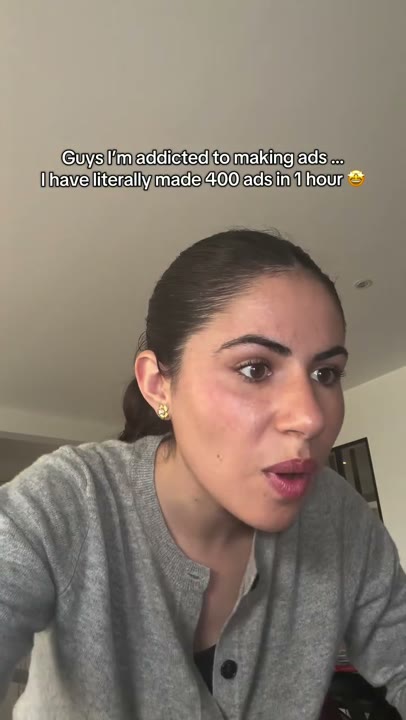
- The creator leans toward an off-screen monitor, widening their eyes and opening their mouth beneath a productivity claim.
- On-screen text
- “Guys I’m addicted to making ads ... I have literally made 400 ads in 1 hour 🤩”
- Spoken line
- “Oh god, look at it.”
- Sound
- An excited spoken reaction; the transcript also records “It's perfect” within 0–3.6 seconds, though its precise timing is uncertain.
Script beats
The 400-ads-in-one-hour overlay accompanies the creator's increasingly amazed reaction to an unseen screen.
Stop scrolling with a specific, unusually large productivity claim and suggest an impressive result
The creator smiles and gestures before the camera switches to monitors showing multiple ad designs.
Resolve the off-screen curiosity with a visible output reveal
The camera surveys a grid of OLIPOP ad variations; “Perfectly on brand” appears around six seconds.
Show variety and position the output as brand appropriate
Closer views show individual soda ad designs alongside a comment-to-receive-the-process overlay.
Make the results easier to inspect and introduce the engagement request
The camera moves across the monitors, ending on a large soda creative while the comment CTA remains.
Finish with a clear example and direct interested viewers toward the workflow
Why it works
- specific numerical claim. “400 ads in 1 hour” makes the promised productivity immediately concrete, although the visible examples cannot verify that count.
- unseen result. The creator reacts to something outside the frame, giving viewers a reason to wait for the screen reveal.
- visible supporting examples. The grid and close-ups provide tangible examples of the claimed output instead of leaving the claim entirely abstract.
- process curiosity. The video shows results while reserving the workflow for viewers who comment, extending curiosity into the CTA.
How to adapt it
- output and quantity. Show 20 edited product photos in 10 minutes, five meal-prep portions in 20 minutes, or a room cleaned in 15 minutes; use a measured result.
- off-screen result. React to a photo editor's finished gallery, an appliance's completed meal, or a cleaning tool's finished surface before revealing it.
- visual evidence. Replace the monitor grid with a phone gallery, a countertop of finished meals, or a wide shot of the cleaned room, followed by one close-up.
- process CTA. Invite viewers to comment “Photos” for editing steps, “Meals” for the recipe, or “Routine” for the cleaning sequence.
- Keep intact.
- Put the specific output-and-time claim on screen immediately
- Keep the result outside the frame during the initial reaction
- Reveal the result promptly after the opening reaction
- Show examples that support the claim and use numbers that can be substantiated
Pattern template
I made [quantity] [outputs] in [time] → react to the unseen result → reveal examples → comment “[keyword]” for the process.
Keywords and tags
- Audience
- UGC creators and marketers interested in producing ad creatives faster
- Angles
- Curiosity, Surprise, Aspiration
- Call to action
- Comment « Ads » to receive the full process
- Sound
- Voice only
Video and caption by @salome__ai; original post on Instagram. Breakdown by UGC Growth Engineer, added .