No product featured
A 12-Hour Study Promise Aimed at Unmotivated Students
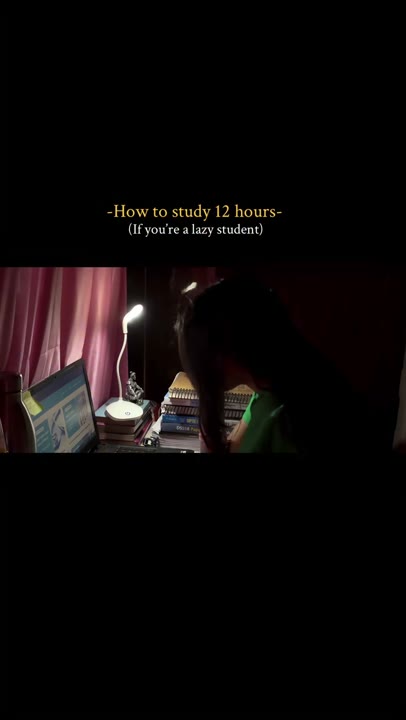
A text-led study montage hooks viewers with a 12-hour study promise for lazy students, shows a familiar desk struggle, and directs them to the caption for the plan.
- Views
- 7.6M
- Likes
- 157K
- Comments
- 646
- Length
- 8s
Observed : 7,564,216 views, 156,970 likes, 646 comments. Published . An Instagram view is a play of a video (Reels); images and carousels have no views.
First 3 seconds
- Visual
- The opening is black with centered text; a dim desk scene gradually appears below it, showing the creator beside a laptop, lamp and books with a hand near their head.
- On-screen text
- “-How to study 12 hours- (If you’re a lazy student)”
- Spoken line
- None: no speech in the opening
- Sound
- Upbeat rhythmic music with no voiceover, according to the prior analysis; the transcript detects no speech.
Script beats
A 12-hour study headline and lazy-student qualifier appear against black.
Make a specific, ambitious promise and identify the intended viewer immediately
A dim side view reveals the creator at a laptop with books and a desk lamp, bringing a hand toward their head.
Ground the promise in a recognizable moment of study frustration
The creator leans forward with hands near their head before the view changes to a rear desk shot.
Extend the struggle and transition toward a more composed studying scene
The rear desk view brightens; the headline remains and a bottom prompt asks viewers to read the caption.
Send viewers to the caption, where the study schedule supplies the promised information
Why it works
- specific outcome. The number 12 makes the promised study goal concrete and immediately understandable.
- self-recognition. The lazy-student qualifier and head-in-hands desk posture invite viewers who struggle with motivation to recognize themselves.
- apparent contradiction. Pairing a demanding study target with low motivation creates curiosity about how the two can coexist.
- deferred explanation. The video presents the promise and struggle while keeping the practical schedule in the caption.
How to adapt it
- Desired outcome. For a planner, promise a manageable exam-revision schedule; for a cleaning tool, promise a quick desk reset; for a meal kit, promise dinner with minimal preparation.
- Audience qualifier. Use 'if you keep procrastinating,' 'if you hate cleaning,' or 'if you never know what to cook' to match the product's audience.
- Visible struggle. Show scattered revision notes before using a planner, a cluttered desk before using a cleaning tool, or indecision at the fridge before preparing a meal kit.
- Resolution and caption payoff. End with the planner in use, the cleared desk, or the prepared meal, then provide the actual steps in the caption.
- Keep intact.
- Put the specific outcome and audience qualifier on screen immediately
- Pair the promise with a visible struggle the intended viewer recognizes
- Keep the headline readable as the footage changes
- If the explanation lives in the caption, clearly direct viewers there and deliver the promised steps
Pattern template
How to [specific outcome] (If you’re [relatable audience struggle]) → show the struggle → show a calmer task scene → read caption for [practical steps].
Keywords and tags
- Audience
- Students who struggle with study motivation and want a structured study schedule
- Angles
- Curiosity, Relatability, Aspiration
- Call to action
- (Read Caption)⤵️
- Sound
- Music only
Video and caption by @tamannah_a_wish; original post on Instagram. Breakdown by UGC Growth Engineer, added .