No product featured
Working-Mom Expectations Stack Up While Tasks Switch
A kitchen text-overlay skit hooks viewers through working-mom recognition, switching from laptop work to cooking as an accumulating list exposes competing expectations.
- Views
- 2.2M
- Likes
- 58.3K
- Comments
- 247
- Length
- 12s
Observed : 2,185,874 views, 58,336 likes, 247 comments. Published . An Instagram view is a play of a video (Reels); images and carousels have no views.
First 3 seconds
- Visual
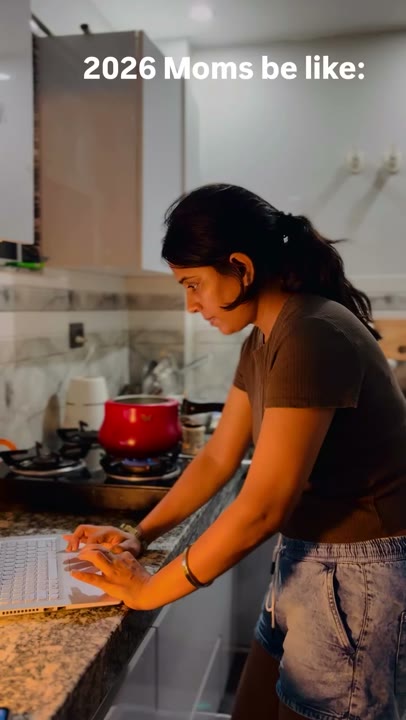
- The creator types on a laptop beside a lit stove, then turns to handle cookware while career and household expectations appear above her.
- On-screen text
- “2026 Moms be like: I need to make money And focus on my career Cook and clean”
- Spoken line
- None: no speech in the opening
- Sound
- Background music with sung vocals, according to the prior analysis and lyric-like transcript; no creator dialogue.
Script beats
The creator types at a kitchen-counter laptop beneath '2026 Moms be like:'.
Establish an immediately recognisable working-mom premise and show work sharing space with household duties
The creator turns toward the stove as money, career and cooking expectations appear.
Make competing responsibilities concrete through a visible task switch
Cooking continues while the list adds being a loving wife, expert parenting and staying in shape.
Escalate the burden through accumulating expectations
The creator handles cookware as 'And have a social life' completes the list.
Deliver the final escalation: even leisure becomes another obligation
The full list remains visible while the creator continues cooking.
Give viewers time to read the cumulative burden and recognise their own experience
Why it works
- self-recognition. The opening names moms and pairs career work with cooking, making the pressure legible before the full list appears.
- visible competing demands. A laptop beside an active stove compresses two responsibilities into one frame; the early turn between them makes the conflict tangible.
- accumulating expectations. Each new line increases the perceived workload and creates a reason to keep watching for the next addition.
- understated performance. The creator's focused task execution lets the overloaded list carry the irony without an exaggerated reaction.
How to adapt it
- Audience and premise. Use 'Freelancers be like:' for a scheduling app or 'New parents be like:' for a meal service.
- Expectation list. For a cleaning product, stack 'Finish work', 'Make dinner', 'Clean the kitchen' and 'Still get some downtime'.
- Adjacent tasks. Show laptop work beside laundry for detergent, or packing a work bag beside lunch preparation for food storage.
- Product resolution. After the list builds, demonstrate a meal kit simplifying dinner or a planner organising tasks; make the benefit visible.
- Sound. Use licensed music with a steady rhythm to pace text additions while keeping the premise understandable on mute.
- Keep intact.
- Identify the relatable audience immediately in a short header
- Show two competing responsibilities in the opening frame
- Switch tasks within the first three seconds
- Add expectations progressively and leave earlier lines visible so the burden accumulates
Pattern template
[Audience] be like: → [task A beside task B] → [switch tasks] → [stack competing expectations] → [optional product simplifies one task]
Keywords and tags
- Audience
- Working moms balancing career, household duties and personal expectations
- Angles
- Relatability, Empathy, Validation
- Sound
- Music only
Video and caption by @justshivi759; original post on Instagram. Breakdown by UGC Growth Engineer, added .