Unbrandedgame-building app
Beginner Game Dev Doubt Followed by a Deadpan Solution
A selfie skit hooks aspiring game developers with exaggerated beginner self-doubt, then switches to deadpan humor and a game-building app demonstration.
- Views
- 79.5K
- Likes
- 2.4K
- Comments
- 277
- Length
- 24s
Observed : 79,463 views, 2,432 likes, 277 comments. Published . An Instagram view is a play of a video (Reels); images and carousels have no views.
First 3 seconds
- Visual
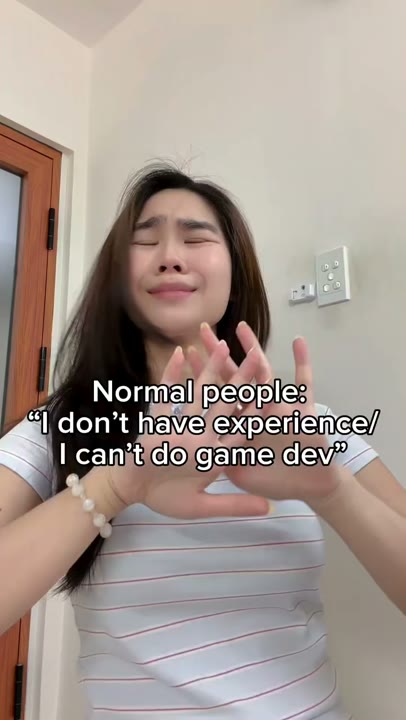
- The creator performs mock distress indoors, closing her eyes, raising her hands, touching her chest, and looking upward beneath a beginner game-development objection.
- On-screen text
- “Normal people: “I don’t have experience/ I can’t do game dev””
- Spoken line
- None: no speech in the opening
- Sound
- Upbeat background music without spoken dialogue, according to the prior audio analysis.
Script beats
The creator theatrically acts out the belief that lacking experience prevents game development.
Make beginners recognize their own hesitation through readable text and exaggerated expressions
The creator drops the worried performance and looks directly at the camera with a neutral expression.
Signal a reversal and create anticipation for the counterexample
A 'Game dev:' meme insert shows a pilot reading a beginner flying book inside a cockpit.
Deliver a visual joke about learning while already doing the task
The video moves to a filmed laptop displaying a game-building website, visible in the 14.13-second contact-sheet tile.
Introduce the tool behind the proposed shortcut
A third-person game appears on the laptop under 'A full playable 3D game 🔥'.
Show a tangible result after the beginner objection
Another game interface appears under 'Some other games it made 👁️👄👁️'.
Expand the demonstration beyond one example
The final laptop shot asks viewers to comment 'GAME' to receive a link.
Convert interest in the demonstrated tool into comments
Why it works
- self-recognition. The opening names a specific beginner belief: no experience means game development is out of reach.
- expressive amplification. The creator's mock distress gives a static text objection movement and a humorous emotional cue.
- expectation reversal. The later deadpan stare and pilot joke challenge the opening assumption before introducing a solution.
- visible payoff. The laptop footage supplies concrete game examples after the skit, making the tool's proposed benefit easier to understand.
How to adapt it
- beginner objection. For a design app: 'I can’t make graphics'; for a meal kit: 'I don’t know how to cook'; for a video editor: 'I have no editing experience'.
- contrast label. Replace 'Game dev:' with 'Me with [product]:' or '[Product] users:' before the confident response.
- visual punchline. Film yourself consulting a quick-start guide while completing the task, or show an original exaggerated learning-as-you-go reaction.
- result demonstration. Show a finished social graphic, a plated meal, or an exported video immediately after the reaction beat.
- comment incentive. Offer a relevant template, recipe, or tutorial with 'Comment [keyword] and I’ll send you the link'.
- Keep intact.
- Put a specific, recognizable beginner objection on screen immediately
- Make the opening expression visibly match the objection
- Preserve the clear shift from mock worry to calm confidence
- Follow the joke with a visible product result that addresses the opening hurdle
Pattern template
Normal people: “I don’t have [skill/experience], so I can’t [task]” → mock distress → deadpan reversal → [user/product] punchline → finished result → comment [keyword] for the link.
Keywords and tags
- Audience
- Aspiring game developers who feel held back by a lack of experience
- Angles
- Relatability, Humor, Curiosity
- Call to action
- Comment “GAME” and i’ll send you the link 👇
- Sound
- Music only
Video and caption by @aiwithwendie; original post on Instagram. Breakdown by UGC Growth Engineer, added .