ProCCDretro camera app
A relatable Y2K selfie wish leads into an app tutorial
A selfie tutorial hooks viewers with a relatable wish for low-quality Y2K photos, shows reference images, then demonstrates the camera app that recreates the look.
- Views
- 159K
- Likes
- 4.9K
- Comments
- 9
- Length
- 17s
Observed : 159,275 views, 4,944 likes, 9 comments. Published . An Instagram view is a play of a video (Reels); images and carousels have no views.
First 3 seconds
- Visual
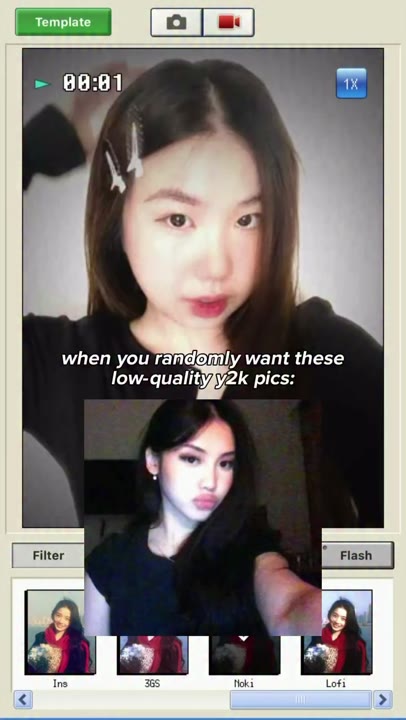
- The creator poses inside a retro camera interface while inset portraits illustrate the desired Y2K look; at about 3 seconds, the video cuts to a phone home screen.
- On-screen text
- “when you randomly want these low-quality y2k pics:”
- Spoken line
- None: no speech in the opening
- Sound
- Background music without spoken voiceover, according to the prior analysis; the transcript detects no speech.
Script beats
Pair a casual selfie preview with a relatable aesthetic wish and changing reference portraits.
Make viewers recognise a specific desire and see the look they could recreate
Show the ProCCD home-screen icon, enter the app, and highlight its Y2K camera with a red circle and arrow.
Turn the aesthetic wish into an immediately actionable app choice
Show selfie poses in the retro camera interface with filter options visible.
Demonstrate the shooting experience and offer poses viewers can copy
Display finished portraits with the overlay 'results <3'.
Deliver visual proof of the promised aesthetic
End on stacked finished selfies with 'follow for more tips ✨'.
Use the demonstrated result to encourage following
Why it works
- self-recognition. The phrase 'when you randomly want' frames an aesthetic craving as a familiar everyday impulse.
- visible target. Inset reference portraits make 'low-quality y2k pics' concrete before the viewer needs to understand the app.
- quick solution reveal. The app appears around 3 seconds, rewarding interest with a clear route to the desired result.
- visual proof. Finished portraits complete the promise established by the reference images.
How to adapt it
- Desired aesthetic. Try 'soft film vacation pics', 'rainy-night city photos', or 'photo booth birthday pics' for a camera or editing app.
- Product and action. Replace the camera selection with a photo editor preset, a compact camera setting, or a clip-on phone lens demonstration.
- Reference and payoff. Open with your own example of the target look, then finish with two or three photos made using the featured product.
- Relatable craving. For a hair tool, use 'when you randomly want these bouncy blowout curls:' with a reference clip, a brief styling demonstration, and the finished hair.
- Keep intact.
- State one specific, recognisable desire in the opening overlay
- Show a visual example of the desired result immediately
- Move quickly from the desire to a clearly identifiable product action
- Finish with results that match the opening promise
Pattern template
when you randomly want [specific look]: → [reference images] → [product + exact setting or action] → [finished results] → [follow/save CTA]
Keywords and tags
- Audience
- People who want to recreate nostalgic Y2K selfies on their phones
- Angles
- Relatability, Nostalgia, Aspiration
- Call to action
- On-screen: 'follow for more tips ✨'; the caption also asks viewers to follow and save the tutorial.
- Sound
- Music only
Video and caption by @mmivia; original post on Instagram. Breakdown by UGC Growth Engineer, added .