No product featured
Workplace Training Parody with a Deadpan Quiz Reaction
A workplace-training parody hooks viewers with a familiar text overlay, then escalates a multiple-choice voiceover while the creator reacts with restrained disbelief.
- Views
- 11M
- Likes
- 698K
- Comments
- 4K
- Length
- 22s
Observed : 11,027,501 views, 698,328 likes, 4,040 comments. Published . An Instagram view is a play of a video (Reels); images and carousels have no views.
First 3 seconds
- Visual
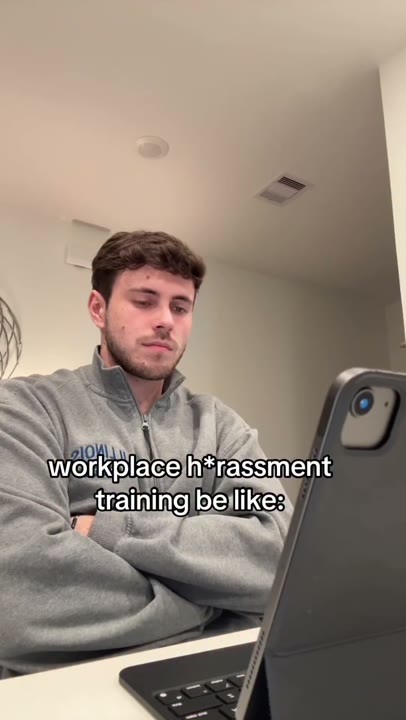
- The creator sits with arms folded at a desk, looking down at a tablet in the foreground with a neutral expression; the camera stays fixed.
- On-screen text
- “workplace h*rassment training be like:”
- Spoken line
- None: no speech in the opening
- Sound
- According to the transcript and prior analysis, a synthetic voice introduces a workplace-harassment multiple-choice question; the creator does not speak.
Script beats
The workplace-training overlay establishes the scenario while the creator watches a tablet with folded arms.
Trigger recognition of mandatory workplace training and introduce the quiz
The voiceover presents accidentally bumping into someone in a hallway as the first option; the creator largely maintains a neutral expression.
Establish an ordinary baseline and keep the numbered question unresolved
The second option describes a congratulatory high five; the contact sheet shows a pursed-mouth reaction around 12.55 seconds.
Extend the familiar quiz structure and build anticipation for the final option
The third option abruptly introduces someone pulling down another person's pants; the creator's expression becomes more furrowed.
Break the mundane pattern with an obviously inappropriate scenario
The voiceover adds explicit, absurd details while the creator tilts their head and reacts with restrained disbelief.
Deliver the escalation and let the facial reaction serve as the closing punchline
Why it works
- self-recognition. The opening overlay names a familiar employee experience before viewers need to understand the audio.
- unresolved question. The multiple-choice structure gives viewers a reason to wait for all three options.
- comic escalation. Two ordinary interactions establish a baseline before the final option becomes flagrantly inappropriate.
- restrained reaction. The creator's small facial changes contrast with the increasingly absurd narration, letting viewers supply their own disbelief.
How to adapt it
- recognizable routine. Use 'meal planning be like:' for a meal-kit brand or 'choosing a password be like:' for a password-manager app.
- three quiz options. For a cleaning product, list two manageable spills and then an exaggerated kitchen mess; for meal kits, list two simple dinners and then an elaborate recipe after a long workday.
- product resolution. After the final reaction, cut to cleaning the mess with the featured product or selecting an easy dinner in the meal-kit app.
- performance and setting. Film at a kitchen counter, vanity, or desk; hold a neutral expression through the first two options and reserve one clear reaction for the third.
- Keep intact.
- Put the recognizable situation in readable text from the first frame
- Establish a calm, deadpan baseline before the escalation
- Use a numbered question that remains unresolved until the final option
- Make the last option clearly more absurd than the first two; brand adaptations can use harmless exaggeration instead of explicit content
Pattern template
[Familiar routine] be like: → Which option [question]? → [ordinary option] → [ordinary option] → [absurd option] → [deadpan reaction]
Keywords and tags
- Audience
- Employees who recognize mandatory workplace compliance training and its obvious quiz questions
- Angles
- Relatability, Humor, Curiosity
- Call to action
- Who else had to take those?
- Sound
- Voice only
Video and caption by @dalmatean; original post on Instagram. Breakdown by UGC Growth Engineer, added .